
Finding the right location for a glamping pod is not always straightforward. A piece of land might offer beautiful views, privacy and excellent potential for tourism, but uneven ground, slopes or difficult soil conditions can make installation more complicated.
For landowners and glamping site operators, the challenge is finding a foundation solution that provides the required stability without creating unnecessary disruption to the site.
Traditional concrete bases remain a suitable option for many projects. However, they are not always the most practical choice, particularly where ground levels vary or extensive excavation would be difficult.
This is where steel piling for glamping pods may offer an alternative.
The British Pod Company offers a no-dig steel piling foundation solution designed to support pod installations in suitable ground conditions, including certain sloping and challenging sites. By using steel piles rather than relying on a conventional concrete base, the system can offer a different approach to preparing land for accommodation.
In this guide, we explain how steel piling works, when it may be appropriate, what landowners should consider and how to assess whether it could be suitable for your glamping development.
What is steel piling for glamping pods?
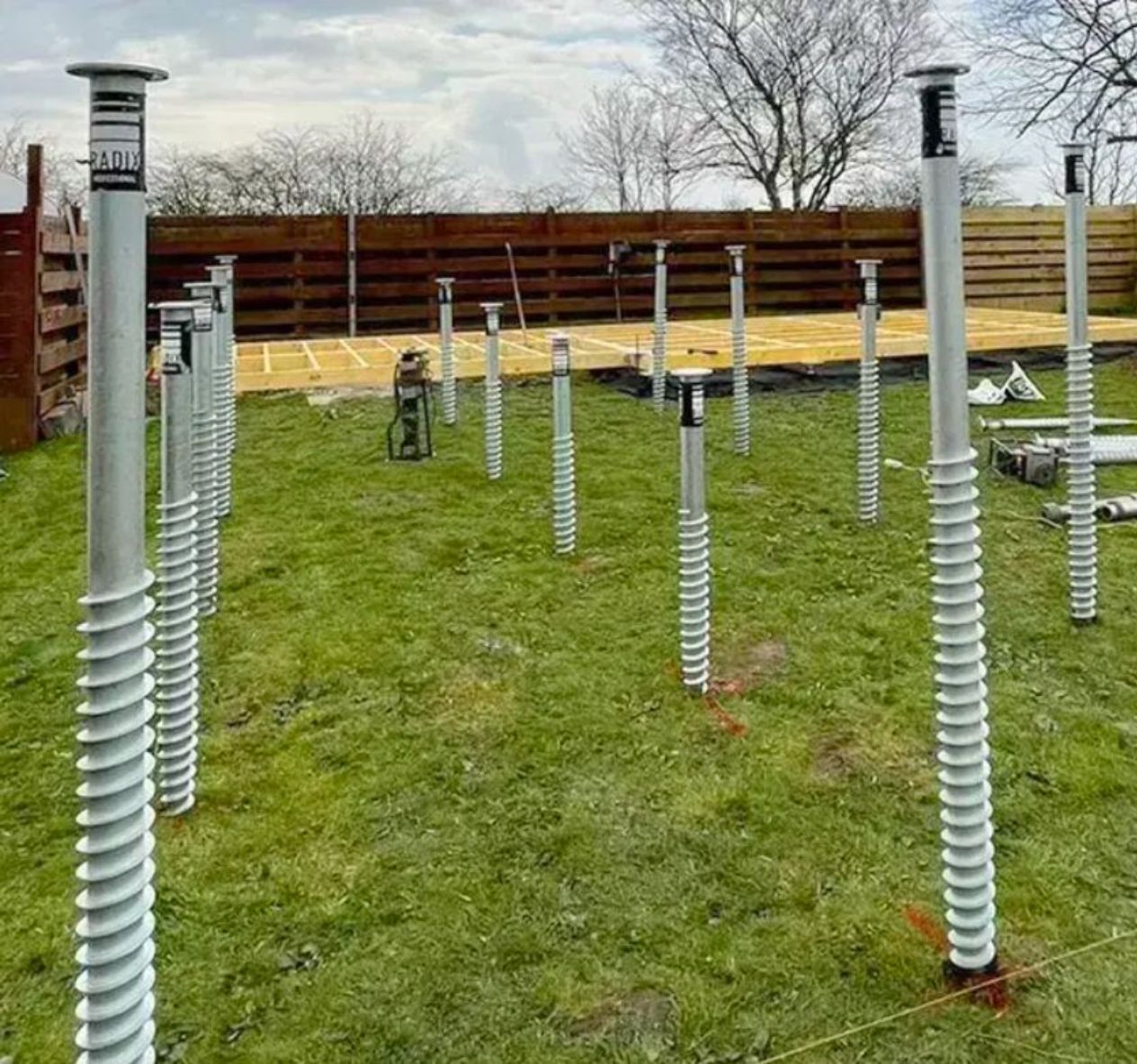
Steel piling is a foundation approach in which steel piles are installed into the ground to provide support for a structure.
Rather than preparing a conventional concrete base across the full footprint of a pod, a piling system uses a series of engineered support points. These transfer the building’s loads into suitable ground, with the design determined by the structure, site conditions and required performance.
The British Pod Company’s steel piling solution is intended as an alternative to traditional concrete foundations for suitable glamping pod installations.
It is particularly worth exploring where the land presents challenges that make a conventional base less attractive.
The exact piling arrangement, installation method and suitability will depend on the project. Ground conditions must be assessed to establish whether the proposed foundation can safely support the pod.
How does a no-dig foundation work?
The phrase no-dig describes the intended approach of reducing the need for conventional excavation and a full concrete base. It should not be interpreted as meaning that no ground disturbance or preparation is required.
In a typical project, the process involves:
- Assessing the site: Reviewing the ground conditions, levels, access and intended pod location.
- Establishing the foundation requirements: Identifying the loads the foundation must support and the relevant structural considerations.
- Planning the piling arrangement: Determining the appropriate support positions and installation requirements.
- Installing the foundation system: Installing the piles using a method suitable for the site.
- Positioning the pod: Connecting the pod to the designed support arrangement and completing the remaining installation work.
The sequence and details will vary depending on the system and the site. A manufacturer or foundation specialist should confirm the installation method for your project.
When might steel piling be suitable for glamping pods?
Not every site needs a piled foundation. A conventional concrete base may be straightforward and cost-effective where the ground is suitable and the land is relatively level.
However, steel piling is worth discussing when a site presents particular challenges.
1. Sloping land and changes in elevation
Sloping land can offer excellent opportunities for glamping accommodation, particularly where elevated positions provide views across countryside, woodland or open water.
The difficulty is that creating a level base on a slope can involve excavation, levelling, retaining structures or substantial groundwork.
A suitably designed piling arrangement may help support a pod at the required level without needing to create a conventional level concrete platform across the entire footprint.
This can be useful where landowners want to work with the existing contours of the site rather than substantially reshape them.
However, a foundation system does not automatically resolve wider slope-stability issues. Steep or unstable ground may require specialist assessment before development can proceed.
2. Uneven or challenging ground
Some sites have variable ground levels, soft areas or ground conditions that make a conventional foundation more complicated.
A piled solution may be worth investigating where the ground can provide adequate support at the required depth, but this cannot be assumed from the surface appearance alone.
A site assessment should establish whether the ground is suitable, how the piles can be installed and whether any additional engineering measures are required.
Where conditions are unsuitable for the proposed system, a different foundation approach may be necessary.
3. Sites where extensive excavation is undesirable
Excavation can involve removing soil, moving materials around the site and arranging for surplus material to be taken away.
On a rural estate or established glamping site, this work may affect landscaping, vegetation, access routes or neighbouring accommodation.
Where the ground and proposed installation allow, steel piling may reduce the need for extensive excavation and a conventional concrete base.
This can be particularly relevant when installing accommodation in an area where retaining the existing landscape is an important consideration.
The actual amount of disturbance avoided will depend on the site, the piling design and the alternative foundation being considered.
4. Remote or difficult-to-access locations
Some rural sites have restricted access for construction equipment and material deliveries. Moving concrete, excavation machinery and other materials into a difficult location can complicate the installation process.
A piling system may offer advantages where its equipment, materials and installation method are compatible with the available access.
It is important to confirm this in advance. Steel piling is not automatically easier to install on every remote site, and access requirements will depend on the equipment and the ground conditions.
5. Glamping developments where future flexibility matters
Some landowners want to introduce accommodation without committing to a more extensive permanent groundworks scheme than necessary.
A foundation system designed to allow the pod to be removed may offer flexibility for certain developments. The British Pod Company highlights the potential to remove its pod installation and restore the land, subject to the circumstances of the project.
This may be worth discussing if future site changes or reversibility are important to your plans.
However, removability should not be confused with automatic permission to install or operate accommodation. Planning conditions, services, landscaping and the actual condition of the site will all affect what restoration involves.
Steel piling vs traditional concrete foundations
Steel piling and concrete foundations serve the same fundamental purpose: supporting the building safely. The differences lie in how they are designed, installed and suited to the particular site.
| Consideration | Steel piling | Conventional concrete base |
|---|---|---|
| Ground levels | May suit certain sloping or uneven sites | May require levelling or additional groundwork |
| Excavation | Can reduce the need for extensive excavation | Often involves excavation or ground preparation |
| Concrete use | Can avoid a conventional concrete base where the system is suitable | Requires concrete for the base |
| Site disruption | May reduce disturbance in suitable circumstances | Can involve excavation, material movement and curing time |
| Ground conditions | Requires assessment of soil, depth and pile performance | Requires assessment of bearing capacity and foundation design |
| Installation access | Depends on piling equipment and site access | Depends on excavation, delivery and concreting requirements |
| Overall cost | Project-specific | Project-specific |
| Removal and restoration | May offer a more reversible approach, depending on the installation | Removing a concrete base can involve additional work |
Neither solution is universally better.
For a straightforward, level site with suitable ground, a concrete base may remain a practical and economical option. On a sloping site or where extensive excavation would be undesirable, steel piling may deserve closer consideration.
The decision should be based on the complete installation requirements and a like-for-like assessment of costs, performance and site impact.
Is steel piling a lower-impact foundation option?
Reducing the environmental impact of a glamping development is increasingly relevant to landowners, rural estates and tourism businesses.
A foundation solution that reduces excavation or avoids a substantial concrete base may offer potential advantages, particularly where preserving the existing landscape is a priority.
However, the environmental benefits depend on the project.
Potential advantages
Depending on the ground and installation method, steel piling may:
- Reduce the amount of excavation required.
- Avoid the need for a conventional concrete base.
- Reduce the movement and disposal of excavated soil.
- Help retain more of the existing ground profile.
- Offer the potential for a removable installation.
These are potential benefits rather than guaranteed outcomes. A conventional foundation may be relatively simple on some sites, while a piling system may require additional equipment or engineering work on others.
Consider the whole development
The foundation is only one part of the environmental picture.
You should also consider access routes, utilities, drainage, construction materials, landscaping, energy use and the way the accommodation will be operated.
If the development is intended to support low-impact tourism, assess the entire project rather than relying on the foundation type alone.
For more information about the planning and site considerations involved in glamping development, read our guide to the Apex for flexible UK glamping development.
Can steel piling make glamping development cheaper?
Potentially, but the answer depends on the site.
The cost of a conventional concrete base includes more than the concrete itself. Ground preparation, excavation, material transport, waste removal and any work needed to accommodate changes in elevation can all affect the final figure.
On a suitable site, a piling solution may reduce some of these requirements.
However, the piling system has its own costs, including the piles, installation equipment, labour, design and any necessary ground investigation. Difficult ground may also require a more complex solution than anticipated.
The best way to compare the options is to obtain quotations that cover the complete foundation installation.
- Site preparation and ground investigation requirements.
- Foundation design and structural considerations.
- Materials, equipment and installation labour.
- Any excavation, levelling or retaining work.
- Access and transport requirements.
- Connections between the foundation and the pod.
- Any additional drainage, utility or landscaping work.
- Assumptions, exclusions and potential additional costs.
This gives you a more meaningful comparison than looking at the headline price of the foundation alone.
For commercial operators, the foundation cost should also be considered alongside the total investment in the pod, site infrastructure and guest facilities.
Does steel piling make planning permission easier?
A foundation method may influence how a development is constructed, but it does not determine the planning outcome on its own.
The British Pod Company highlights the potentially less invasive nature of its piling solution and the opportunity to remove a pod installation. These features may be relevant when discussing the proposal with the planning authority.
Nevertheless, a glamping pod on steel piles can still constitute development requiring planning permission or other approvals.
Planning authorities may consider the intended use, location, access, appearance, landscape impact, drainage, environmental constraints and other factors.
A removable structure is not automatically exempt from planning requirements, and a foundation that avoids extensive concrete does not guarantee approval.
If you are developing a new glamping site, adding units to an existing holiday park or placing a pod on rural land, establish the planning position before committing to installation.
The British Pod Company offers planning-related support for glamping projects. Find out more about its planning permission service and complete project services.
Is steel piling suitable for every type of ground?
No. Ground conditions are one of the most important factors in deciding whether a piling system is appropriate.
The British Pod Company identifies sloping land, elevations and challenging terrain as potential applications for its steel piling solution. It also notes that rocky ground may require an alternative solution.
The following conditions illustrate why a site-specific assessment matters.
Soft or variable ground
The surface may appear suitable, but the depth and properties of the underlying soil determine whether the proposed foundation can provide the necessary support.
Ground investigation may be needed to understand bearing capacity, settlement and other risks.
Rocky ground
Rock can affect whether piles can be installed using the intended method. Depending on the geology and system, an alternative foundation design may be required.
Unstable slopes
A piling system may provide support for a pod, but it does not automatically stabilise a hillside. Where there is a risk of landslip, erosion or ground movement, specialist geotechnical advice is important.
Made ground or previously developed land
Previously filled or disturbed ground can contain variable materials and concealed obstructions. Ground investigation may be needed to establish whether piling is appropriate and identify any additional risks.
Ground affected by water or contamination
Groundwater, drainage patterns and contamination can affect foundation design and installation. These issues need to be assessed where relevant, particularly on sensitive sites.
The general principle is straightforward: choose the foundation to suit the site, not the site to suit an assumed foundation solution.
A competent foundation specialist should determine the appropriate approach based on the available ground information, structural requirements and intended installation.
What does the installation process involve?
If you are considering steel piling for a glamping pod, it is sensible to establish the foundation requirements early in the project.
This can help avoid designing a site layout around assumptions that later prove impractical.
Step 1: Assess the proposed location
Identify the intended pod position, ground levels, access routes and any obvious constraints.
Consider nearby trees, existing structures, drains, service routes and the relationship between the proposed accommodation and the rest of the site.
Step 2: Establish the ground conditions
The required level of investigation depends on the site and the risks involved. A visual inspection may identify obvious issues, but it cannot always establish the strength or depth of suitable supporting ground.
Where necessary, arrange appropriate ground investigation and engineering advice.
Step 3: Confirm the pod and foundation specification
The weight, dimensions and design of the selected pod influence the foundation requirements.
Agree the intended model and layout with the manufacturer so the foundation can be assessed against the actual structure and installation.
Step 4: Compare foundation options
Ask whether steel piling is suitable and compare it with a conventional concrete base or any other appropriate option.
Consider cost, installation time, ground disturbance, access and future removal requirements.
Step 5: Confirm services and site preparation
Even if the foundation reduces the need for excavation, the site may still require water, electricity, drainage, access, paths and landscaping.
Plan these elements together so that the foundation and wider installation work can be coordinated.
Step 6: Arrange installation
Confirm who is responsible for the foundation, pod delivery, positioning and final connections.
Agree the scope of work, programme, site access requirements and any inspections or approvals needed before the accommodation is used.
Steel piling for holiday parks, rural estates and private land
The same foundation option can be relevant to different types of project, although the priorities will vary.
Holiday park operators
For an established holiday park, adding pods may involve working around existing accommodation, paths, landscaping and utilities.
A foundation solution that reduces extensive excavation may be worth considering where conventional groundwork would disrupt the site’s operation.
However, the overall installation plan must still account for guest access, safety, drainage and the positioning of new units.
Farmers and rural landowners
Land that is attractive for tourism may not be level or easy to develop.
Steel piling may offer an option to investigate where the terrain makes a conventional base less appealing. The suitability of the site, planning requirements and potential demand should all be assessed before committing to a development.
For a wider overview of the business considerations, read Farm Diversification with Glamping Cabins.
Homeowners
Homeowners considering a garden pod or guest accommodation may also encounter sloping gardens, uneven ground or restricted access.
Steel piling could be worth discussing for a suitable installation, but the intended use of the building is crucial. A garden office, incidental garden building and self-contained holiday let may be subject to different requirements.
Check planning and building requirements for the proposed use, and ensure the foundation is designed for the actual structure.
Why consider The British Pod Company's steel piling solution?
The British Pod Company manufactures glamping pods and leisure accommodation in Lancashire and offers a steel piling foundation option for suitable installations.
Its published solution is designed to provide an alternative to a conventional concrete base, particularly where the land presents challenges such as slopes, elevations or difficult ground conditions.
For landowners and operators, the important first step is to establish whether the system is appropriate for the proposed site.
The team can discuss the intended pod, the location and the installation requirements, helping you understand which options may be suitable and what further assessment is needed.
You can also explore the company’s wider services, including planning-related support and site infrastructure.
Frequently asked questions about steel piling for glamping pods
What is steel piling for glamping pods?
Steel piling is a foundation method that uses steel piles to support a structure. For suitable glamping pod installations, it can provide an alternative to a conventional concrete base. The design and installation requirements depend on the pod and the ground conditions.
Can glamping pods be installed on sloping land?
Potentially, yes. A suitable foundation system may allow a pod to be supported on sloping or uneven ground without creating a conventional level concrete base across the entire footprint. The slope, soil conditions and wider site stability must be assessed before installation.
Is steel piling better than a concrete base?
Neither is always better. Steel piling may be advantageous where excavation or a conventional concrete base would be difficult or undesirable. A concrete base may be more practical on a straightforward site. Compare the complete design, cost, performance and site impact before deciding.
Does steel piling avoid all excavation?
No. The approach may reduce the need for extensive excavation and a conventional concrete base, but some site preparation and ground disturbance may still be necessary. The installation method and requirements depend on the site.
Can steel piling be used on rocky ground?
Not necessarily. Rocky ground can prevent or complicate the installation of a particular piling system. The British Pod Company advises that alternative solutions may be needed in such circumstances, so an assessment is essential.
Is steel piling an environmentally friendly foundation option?
It may reduce some impacts associated with excavation and conventional concrete foundations in suitable circumstances. However, the overall environmental impact depends on the ground conditions, materials, equipment, installation method and wider development. It is best to assess the complete project rather than assume that piling is always the lower-impact option.
Does a steel-piled glamping pod still need planning permission?
It may do. The foundation method does not automatically exempt a development from planning permission. Requirements depend on the location, proposed use and wider circumstances of the project. Check with the relevant local planning authority before proceeding.
Can a pod on steel piles be removed later?
A suitably designed installation may allow the pod and foundation components to be removed, but the practicalities and extent of restoration depend on the system, site and services. Confirm the removal arrangements with the manufacturer and consider any planning conditions that apply.
How much does steel piling cost for a glamping pod?
Costs depend on the pod, ground conditions, pile design, access, installation requirements and any additional engineering work. Request a site-specific quotation and compare the complete cost with alternative foundation options.
Explore foundation options for your glamping pod
Challenging ground does not necessarily mean a glamping project is impractical. In some circumstances, a steel piling foundation can provide a useful alternative to a traditional concrete base, particularly where the site is sloping, uneven or difficult to access.
The key is to establish what the land can support, assess the intended accommodation and compare the available foundation options before committing to the development.
The British Pod Company’s steel piling solution is designed for suitable glamping pod installations where a conventional concrete base may not be the preferred approach.